
When it comes to evaluating your website’s performance, speed tests are often one of the first tools that businesses turn to. After all, nobody wants a slow website that drives visitors away or hurts search engine rankings. There are plenty of tools available for assessing page speed, with GTmetrix and Google PageSpeed Insights being two of the most commonly used.
At Inspry, we typically prefer GTmetrix over Google PageSpeed Insights for a variety of reasons, but it’s important to understand that all speed tests should be taken with a grain of salt.
In this blog post, we’ll explain why we favor GTmetrix, why speed test results should not be your sole focus, and how allocating time and resources to other business or marketing efforts may offer more impactful results than obsessing over perfect scores on these tests.
Why Speed Matters for Websites
Before diving into tool comparisons and caveats, let’s address the fundamental question: why does speed matter?
A faster website improves user experience, which can lead to higher engagement, reduced bounce rates, and more conversions. Search engines like Google consider page speed as part of their ranking algorithm since they ultimately do not want to send users to slow websites. With this in mind, a slow-loading site may impact your SEO and overall visibility.
That said, while speed is an important factor, it’s not the only one. Website performance is a combination of multiple factors like content quality, user experience, functionality, and SEO optimization. Focusing exclusively on speed, especially when using standard tests, can sometimes lead to diminishing returns quickly.
GTmetrix vs. Google PageSpeed Insights
Both GTmetrix and Google PageSpeed Insights aim to measure the performance of your website, but they do so in different ways and with different metrics in mind.
GTmetrix
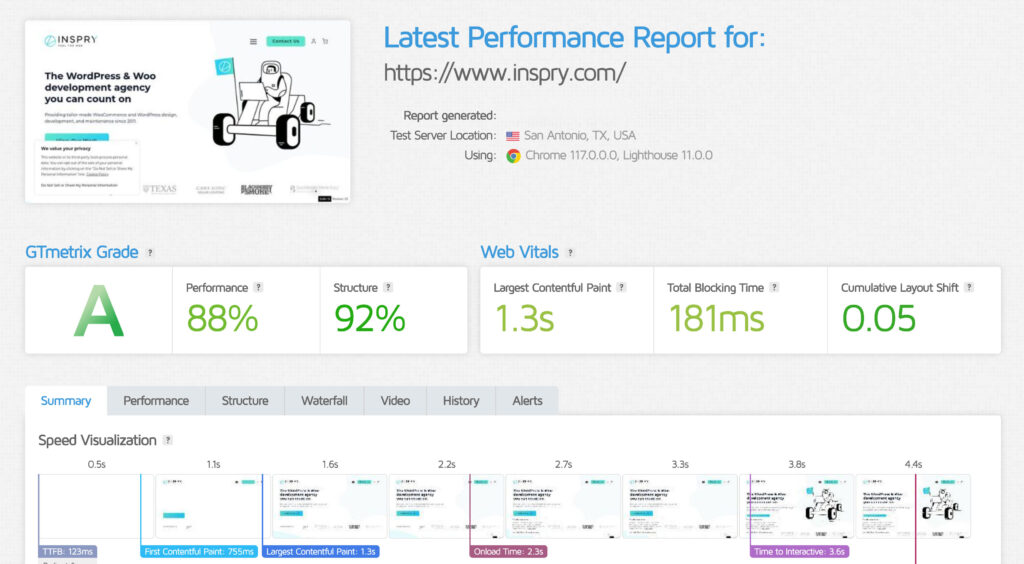
GTmetrix provides an in-depth performance analysis, giving you a detailed look at your site’s load times, structure, and specific areas that may need improvement. It tests websites based on real-world performance scenarios by using various browsers (Chrome, Firefox) and device settings (desktop, mobile). GTmetrix offers a Waterfall Chart that breaks down every single request made during the loading process, providing a granular view of what’s happening on the page.
Key Benefits of GTmetrix:
- Comprehensive Breakdown: Offers detailed insights into every aspect of website loading, including third-party requests, CSS/JS render-blocking issues, image sizes, and more.
- Real-World Testing: Simulates performance across different devices, browsers, and connection speeds, which is closer to how your actual users will experience the site.
- Focus on Load Time: GTmetrix focuses on user-centric metrics such as Fully Loaded Time, which measures the complete loading of your page.
Google PageSpeed Insights
Google PageSpeed Insights (PSI) is another popular tool that analyzes page speed but emphasizes different metrics. It grades your website performance on a scale of 1 to 100, with higher scores reflecting better optimization. Google PSI focuses on Google’s Core Web Vitals, which includes metrics like First Contentful Paint (FCP) and Largest Contentful Paint (LCP). These metrics are part of Google’s SEO ranking factors, making them important for website visibility.
Key Benefits of Google PageSpeed Insights:
- Google’s Core Web Vitals Focus: Because Google uses Core Web Vitals as a ranking factor, PSI can offer a direct look at how your site may perform from an SEO perspective.
- User-Centric Metrics: PSI places emphasis on how quickly users see content on the screen, which can be useful for improving the perceived performance of a site.
- Actionable Suggestions: Google PSI provides recommendations for improving site speed, often focusing on things like image optimization and script loading.
Why We Prefer GTmetrix Over Google PageSpeed Insights
Now that you know the basic differences, let’s dive into why we at Inspry often choose GTmetrix over Google PageSpeed Insights for our clients.
- More Realistic Testing Conditions: GTmetrix simulates real-world scenarios more accurately, testing websites in various environments with different browsers, devices, and connection speeds. Google PSI, while useful, sometimes focuses too heavily on theoretical conditions that don’t always match the diverse real-world experiences of your site’s visitors. GTmetrix provides a more holistic view of how a website is likely to perform for the average user.
- Detailed Waterfall Analysis: GTmetrix’s Waterfall Chart is a standout feature. It breaks down every single request made during the page load process, such as images, scripts, and third-party integrations. This allows us to identify bottlenecks more precisely and optimize where it will actually impact the user experience. In contrast, Google PSI provides a more abstracted view, focusing more on generalized issues rather than deep-dive analysis.
- User-Centric Metrics Like Fully Loaded Time: GTmetrix’s “Fully Loaded Time” is an important metric because it tells you when the entire page has finished loading. This is closer to how users perceive a website’s speed. Google PSI, while focusing on important metrics like Largest Contentful Paint (LCP), may give you a high score even if the site feels slow to real users, especially when elements like ads or interactive scripts delay the full loading experience.
- Better Diagnostic Tools for Developers: For technical troubleshooting and improving site performance, GTmetrix offers more advanced diagnostic tools. Its detailed reports make it easier for developers to pinpoint the exact cause of slowdowns and address them efficiently.
Overall Speed Tests Should Be Taken With a Grain of Salt
While GTmetrix may offer more detailed insights than Google PageSpeed Insights, it’s important to emphasize that both of these tools have limitations.
- Speed Scores Aren’t the Full Picture: Speed tests, by their nature, focus on measurable metrics like page load time and various optimization techniques. However, these scores don’t always correlate directly with user experience or business outcomes. For instance, a website could score well on a speed test but still perform poorly in terms of conversions, usability, or customer satisfaction.
- Over-Optimization Can Be Counterproductive: Chasing after a perfect score can lead to diminishing returns. Websites that over-optimize for speed may strip away important features or visual elements that enhance user engagement. For example, reducing image quality too much or deferring scripts can sometimes hurt the user experience more than it helps. Furthermore, as the low hanging fruit is managed, smaller optimizations can often be the mostly costly with little chance of return on investment. A balance must be struck between a fast-loading site and one that delivers rich, engaging content.
- Speed Alone Won’t Drive Business Success: Spending excessive time and money trying to get a perfect score on a speed test may not have as much impact as you think. While site speed is important, factors like content quality, user experience, and marketing strategies will ultimately play a more significant role in your site’s success. It’s easy to get caught up in technical optimization efforts that don’t necessarily contribute to your broader business goals.
- Test Variability: Speed test results can vary depending on a number of factors, including the time of day, server load, and geographic location of the test. This variability means that speed test results can change even without any updates to your site, leading to inconsistent results. Focusing too much on these tests could cause unnecessary concern or lead you to make changes that don’t have a meaningful impact on your users’ experience.
Focus on What Truly Moves the Needle
Trust us, we love working on speed optimizations and geeking out on GTmetrix, but ultimately we often don’t think this is the most important use of a client’s budget. With that in mind, what should businesses focus on instead? Here’s how you can make better use of your time and resources:
- Content and User Experience: A website’s ultimate goal is to serve its users. High-quality content, intuitive navigation, and a smooth user experience are far more likely to generate leads, sales, and long-term customer loyalty than marginal improvements in load times. Don’t just take our word for – visit a well known website and its a good bet that they have what’s considered a ‘bad’ speed score because they are focused on the overall website experience and other website improvements over just speed.
- Conversion Rate Optimization: Instead of chasing a perfect speed score, focus on optimizing for conversions. Analyze how users interact with your website and identify areas for improvement, such as streamlining the checkout process or improving call-to-action buttons. Small tweaks in user experience and design can have a much greater impact on your bottom line than shaving milliseconds off your load time.
- SEO and Marketing Efforts: While page speed might play a role in SEO, it’s just one of hundreds of factors Google considers when ranking websites. High-quality content, effective keyword targeting, and strong backlink strategies will do more for your visibility than achieving a high Google PageSpeed score. Allocating resources toward comprehensive SEO and marketing strategies is likely to yield better long-term results than hyper-focusing on speed optimization.
- Regular Maintenance and Optimization: Rather than obsessing over speed test scores, focus on regular website maintenance and optimization. Ensure that your site is running efficiently by keeping plugins up to date, optimizing images, and conducting regular performance audits. These efforts, combined with strategic marketing, will help you maintain a competitive edge without getting bogged down by the minutiae of speed tests.
Balance is Key
While tools like GTmetrix and Google PageSpeed Insights offer valuable insights into your website’s performance, it’s important to view their results in context. Speed is certainly a factor to review within the context of a good user experience and SEO, but it shouldn’t come at the expense of other critical aspects like content, functionality, and marketing strategies.
At Inspry, we prefer GTmetrix for its detailed analysis and realistic testing conditions, but we also recognize that chasing perfect speed scores may not always be the best use of your time and money. Instead, we recommend focusing on a balanced approach that optimizes your site for real users while prioritizing broader business goals.
That being said, we do offer website speed optimization for your WordPress site, and we can help you identify and address any quick wins to improve your speed scores, allowing you to allocate the rest of your budget toward website improvements that deliver long-term results.